Thursday, 19 July 2012

3rd in the series '1st Year Out of Uni' Interview with Sophie Victoria Elliott


Collage and pen drawing, A3, 2012


The third artist I have interviewed as part of this series is Sophie Victoria Elliott. Elliott graduated from Swansea Metropolitan University last year after completing a degree in Fine Art. Her practice explores her fascination with the geological landscape, which she explores through a wide variety of mediums. 

Sophie Victoria Elliott is based between Cardiff and West Yorkshire.

Elizabeth Dismorr: What do you miss (if anything) about being in an educational environment?

Sophie Victoria Elliott:      
 *The access to equipment
*Lectures from both lecturers from the university and visiting lecturers.
 *Feeling of a critical support network from fellow students and our tutors (the loss of critical support was the biggest difference as within 2 months of leaving University I was living in Yorkshire alone, having moved from Swansea, in a studio on my own working in a school). However, once I stepped back from University I saw that this support network is equally as damaging as supportive i.e. friends and fellow class mates were rarely brutal.

ED: Do you feel that you have managed to balance earning enough money to live with practicing as an artist?

SVE: I was fortunate to get a position as an Artist in Residence at Ackworth School, Pontefract and knew this in the March 2011 before I had even completed my degree. This has allowed me to work part-time as a teacher and concentrate on my practice the rest of the time. However, I know how fortunate I am to have the balance of money and time for the moment as most fellow graduates are not in this position.

ED:Have you taken part in any unpaid work experience/internships/volunteering? Do you think these will stand you in good stead to finding a job?

SVE: I have volunteered as:
BEEP Wales’ International Painting Prize – helping hang the show
‘Inside’ Exhibition, Blankspace, Manchester - Artist assistant for Philip Cheater
Elysium Gallery – taking show down ready and paint for next show
g39 archivist and library assistant
'Future Memory in Place' arts project, Swansea – teacher

The above volunteer positions offer me the opportunity to network, understand the workings of different galleries and organisations and I believe will help develop skills that make me more employable. I also enjoy the opportunity to learn how to hang a show, support an artist, archive etc.

ED: How has your practice evolved in the last year?

SVE:Being away from the university environment was initially daunting, but I experienced a freedom not felt since Foundation. Not having to adhere to box ticking and ‘final pieces’ released me and I began to explore far further and have since begun 3 collaboration projects with other artists, something I would never have been encouraged to do at university.  Engaging in collaborations can offer a critical support for all involved and as your making work together there is a brutal honesty as your potential reputation is at stake. The new location, Yorkshire, also instigated a new avenue of work.  I would say that my working methods have not changed but, instead, I regained the confidence that University caused me to momentarily lose.

  ED: Have managed to participate in many exhibitions/events in the year since you have graduated?

SVE:

Solo Exhibitions
2012
'Cyclical Culminations' 12th July - Milkwood Gallery, Roath, Cardiff 
'A Landscape Interpretation' Ackworth School Summer Exhibition 7th July - Solo Show, Yorkshire

Group Exhibitions
2012
REIMAGINE WREXHAM 9th June - 18th July - Group Show/ Interventions, Wrexham [How Far Is Home? performance 11th July]
Citizen III – tactileBosch, Cardiff 
Art.Spoke.Soul. – Print Haus, Cardiff
IlluminARTy: The Gift - Swansea

2011
Red Door 44 Grand Opening Exhibition - Red Door 44, Swansea
JOY - Exe One Zero, Monkey Café, Swansea
Graduate Show Reel - Mission Gallery, Swansea

Forthcoming Exhibitions
2012
BEEP: Wales International Painting Prize, Volcano, Swansea
Disruption2 – 'How Far Is Home?' Performance, Swansea
Pre-paper: Post-card - group exhibition, Red Door 44, Swansea
Solo Exhibition – South Square Gallery, Thornton, Yorkshire
Made In Roath 2012 - Cardiff 

Projects
2012 - present
How Far is Home? Project
Collaboration Project – DIS / location
Red Door 44 – Co-founder, collective member and website and social media developer

Forthcoming Projects & Other Experiences
2012
Pushing Too Many Pencils – contribution to quarterly zine
Collaboration Project with Beccie Evans and Emily Baines
Collaboration Project with Jason and Becky

2011
Co-curated ‘Sophie Jacobsen: Prints’ – Osaka-ko,  Japan


ED:   What do you hope to achieve in terms of your practice and career as an artist?

SVE: To develop and refine my visual dialogue; to be able to communicate to others the instigation and inspiration of the work. I also wish to be able to create educational packages/workshops for students to engage and be inspired by the artworks, and most importantly, not feel ostracised by it.

     ED: Many British artists are drawn to moving to London after they have graduated. Have you felt this pull?

SVE:Landscape inspires and drives my work so travelling to many different locations is at the heart of my practice. I imagine I will want to move from West Yorkshire next year but London does have a natural gravitational pull but I am aware the promises of success aren’t as simple as merely moving to London. To be able to be involved in the London Arts scene for a small but intense period appeals to me but so does the Glaswegian arts scene, Bristolian and Mancunian among many others. However, the Swansea and Cardiff arts scene are brilliantly saturated and inspiring with collaborations and opportunities available to create at the moment.

  ED: And finally – what advice would you give to any artists who have just graduated in 2012 and are keen to make it as an artist?

SVE:Don’t treat your graduate show as a full stop and a ‘final piece’. It is merely the beginning and though there may be a fear about the loss of your support network as the university studios disband, allow this to offer you a new freedom and either search out a new critical forum or even set up your own.


Your can find out more about Sophie by looking at her website and blog.

To find out more about Red Door 44, the artist collective she help set up and run click here

Monday, 16 July 2012

Review - Pull Everything Out, Corita Kent and Ciara Phillips


Pull Everything Out
Corita Kent and Ciara Phillips
Spike Island, Bristol

Corita Kent 'E eye love' , 1968


Pull Everything Out is an exhibition showing works by the late artist and educator Corita Kent, and Canadian born Ciara Phillips. Corita Kent (1918-1986) is best known for her screen prints from the 1960’s, taking images and text from popular culture. Ciara Philips is a contemporary artist, who like Kent uses print.

Walking into the main gallery space the viewers eyes are greeted with large day-glo prints embellished with slogans and images from magazines with an often political message. It was surprising for me to discover that Corita Kent spent much of her life as a nun. Alongside this work Ciara Phillips has created her own work in reaction to Kent’s, either in the form of prints or by painting directly onto the walls of the gallery. In this manner, therefore, Phillips has entered into a dialogue with the late artist. Phillips work accentuates the older artists work. Much of her work, such as the abstract marks made upon the walls are often visual quotations from the passages within Kent’s prints, and thus also display a connection to language. The main gallery space is joyous with its colour and excubarance. Despite the amount of work on display the space does not appear overcrowded; instead Kent’s work appears to lead, with Phillips dancing alongside, adding flourishes here and there.

For the first month of the exhibition Ciara Phillips has set up a working studio in the front gallery. However, although there was evidence of Phillips working in the space, it seemed almost staged when I visited. The space was too pristine to appear like a true working studio, and I suppose that it did not help that there were original copies of ‘The Bulletin’  placed under glass in the studio space, making the work shop space seem half like a museum. I think it will be interesting to visit the front gallery at the end of the month, to see more evidence of Phillips having worked in the space.

My favourite part of the exhibition was a film showing Corita Kent teaching her students. It was clear from watching the film what an inspirational teacher the nun was. Dressed in her full habit Kent instructed students on a collaborative project involving images and slogans and magazines which were then printed onto boxes with the boxes then placed upon each other. As I watched the film I wanted to take myself back forty five years and join the kohl rimmed, turtle necked students in their project. I wish there were more educators like Corita Kent in art schools today. 


The exhibition runs until the 26th August 

Friday, 6 July 2012

2nd in 1st Year Out of Uni interview series.


SooMin Leong, Little Tree House In The Woods, 2012


My second interview in this series is with Bristol based artist and printmaker, SooMin Leong. SooMin graduated from Bristol UWE with an MA in Printmaking in 2011. I wanted to see how the last year has treated her, in terms of the development of her practice but to also see if she has managed to balance that delicate line between earning enough money to live, and being able to still make art. 


Elizabeth Dismorr:  What do you miss (if anything) about being in an educational environment?
SooMin Leong: Technical assistance and critical comment/advice from tutors and course mates.

ED:Do you feel that you have managed to balance earning enough money to live, with practicing as an artist?
SL: No. Especially to begin with.

ED: Have you taken part in any unpaid work experience/ internships/ volunteering since university? Do you think these will stand you in good stead to finding a job? 
SL:I started with volunteering and internships. It can be a good way to know people and also show people I am capable and reliable. 
 I had volunteered at Spike Island since autumn, and have just stopped volunteering there because I am now a paid invigilator. I've also Volunteered at M Shed since autumn, helping up in events and also operating the printing press. I am not volunteering there at the moment because they just kept the press away. However, if there are some interesting projects coming up, I will still volunteer for them, especially if it includes printing. I also I volunteered for Bristol Civic Society as their 'talks' photographer for a few events. Lastly I spent 3 months (January til early April)doing a  paid internship with Arnolfini as an archive intern. For this I catalogued the artist's book collection at Bristol Records Office. 

ED: Have you managed to participate in many exhibitions/events in the year since you have graduated? 
SL: Some:

f16 -- photography exhibition during photography festival.
The secret postcard show 'Six by Four' for the UWE MA Fine Art Fundraiser, I also participated in Seila Fernandez Arconada's show Secret Whispers. And my solo show, Traverse. And also some pop up shops, Made in Bristol, and Paper Scissors Stone. 

ED:How has your practice evolved since you left university? 
SL: I am still working on the same idea, slowly move on from that. Try to produce different things with the same idea, such as books and also other 2D works besides my 3D layered photographs.

ED: What do you hope to achieve in the next year in terms of your practice and career as an artist? 
SL: Hopefully, my work will get into more galleries and exhibitions. And also some part time jobs or a full time job related to art along side.

ED: Do you think you'll stay in Bristol? 
SL: Yes, for the moment. However, I might move to other places, if I get opportunities else where.

ED: What advice would you give to anyone about to graduate in an arts related subject and keen to make it as an artist? 
SL:Keep inspired and the passion and belief you have will bring you through. 


SooMin Leong's show Traverse is at The Gallimaufry on Gloucester Road in Bristol until the 21st of July. 


To find out more about SooMin and her work, take a look at her website

Tuesday, 3 July 2012

My Studio

My studio is currently in a spare room in my house. It doubles up as a laundry room and a place to store stuff. However, my table sits by the French windows, giving some light, along with a rather wobbly vintage 70's lamp. The space is extremely cold in winter, and I sit huddled over the table in layers of knitwear, the smell of white spirit and oils penetrating my nostrils. On and around the table are my tools of the trade (oil paints, watercolours, brushes etc) various old postcards that I collect, art books and magazines, rejected pieces of art and work in progress. It is messy, but whenever I go in to work there I find my self escaping from whatever else life is throwing at me and create some work (whether the work is good or bad is another matter!). 


Work in progress for a project I'm doing on Bletchley Park

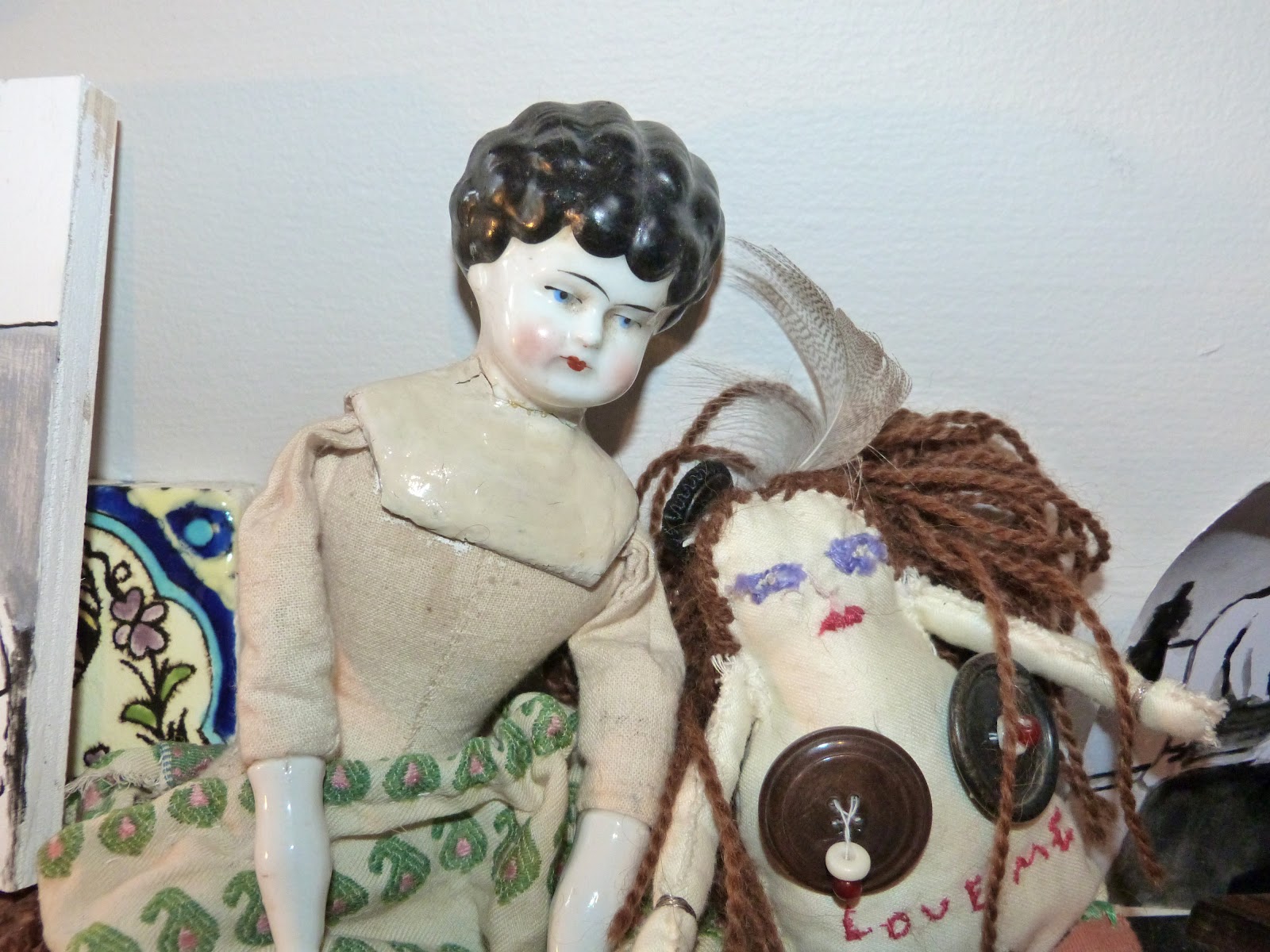
I have a penchant for Victorian dolls. The other one I made some years ago.

The table, and one of my cats

The studio doubles up as a laundry and storage room!

Saturday, 30 June 2012

Review: 7th Berlin Biennale


Miroslaw Patecki, Christ the King

 This year Berlin held its 7th Biennale. Begun in 1998 it has seen Berlin emerge as one of the art capitals of the world. The 7th Biennale had people talking as soon as the infamous Artur Zmijewski was said to be curating the show.  The Warsaw born curator is known as much as for his ego, as for  his provoking, uncompromising artwork.  His manifesto The Applied Social Arts in which questions such as ‘Does art have any political significance’ and ‘can art change reality’ formed the point of departure for the 7th Berlin Biennale.

   With the heavy political theme running throughout,  it was always going to be an exhibition which provoked and infuriated some, and at the very least made you react. I reacted as soon as I entered the corridor leading up to the first floor of the Kunst – Werke Institute for Contemporary Art. The ground floor had been taken over by the occupy movement (invited by Zmijewski) and for this reason the corridors and stairs were covered in stencil art, and signs put up with peeling pieces of gaffer tape, and scrawled messages. If you wanted the antithesis of a ‘white cube’ space, or exhibition, this was it.

   The first floor saw the space being taken over by a huge head of Jesus, created by Miroslav Patecki. The head was a replica of the one that he created for the Christ statue, Christ the King in Swiebodzin, Poland. Patecki had been working on the polystyrene head throughout the exhibition with part of the gallery space as his workshop. I saw it in its final guise and I couldn’t take it in. The piece was meant to display ‘a perfect face of Christ’, although the disembodied head did little to enlighten my Christian leanings, especially as it was topped with a shoddily made crown which seemed several sizes too big. I feel that I would have gained more than simply bemusement from the piece if I had seen the piece whilst being made.  In its completed state alongside the empty studio space it looked like an oversized prop for a theatre. 

   PM 2010,a work by Teresa Margolles a year’s supply of the  tabloid newspaper covers  published in one of the most dangerous border cities in Mexico. The majority of the pages displayed grainy pictures of fatally shot victims in blood smeared clothing, and next to this, bare breasted models. This juxtaposition of the images seemed too absurd to be true and yet they were.

   In response to Margolles installation, Antanas Mockus, former Mayore of Bogota and political thinker created a piece titled Blood Ties. For the piece he asked people to donate a drop of their blood and choose to sign a legal waiver stating that they would not consume drugs during the Berlin Biennale as a statement against the Mexican drug wars. In conjunction to this a Mexican flag and book were placed on a lever over a bucket of liquid. When people signed the waiver and donated their blood the flag and book were hoisted into safety. When I viewed Blood Ties the flag and book were dipped in the pool of liquid, sodden and water damaged. Apparently due to health and safety regulations visitors were no longer allowed to give blood and thus the piece had stalled, leaving the sodden flag and book dipped in the liquid, and a table messy with the signed declarations of the waiver. 

  On the top most floor of the KW housed Polish artist, Lukasz Surowiec’s  project, Birke. Surowiec had taken Birch Tree saplings from the Nazi concentration camp, Auschwitz-Birkenau and had planted them throughout Berlin, including two in the courtyard of the KW. The viewer was greeted with tables upon which pots of birch seedlings rested under bright lights, ready to be taken away by the visitor and planted wherever you chose. In a darkened room a video also showed the process of removing the saplings from Auschwitz and then replanting them around Berlin.  I found the idea behind the piece to be beautiful, and there was something moving about seeing the two saplings out in the courtyard on a grey wet day, their thin branches fighting against the wind that made me conclude, that although not all the works exhibited fufill Zmijewski’s manifesto, ones like Birke certainly leave the world a more eloquent, thought provoking place. 

Sunday, 24 June 2012

No.1 From 1st Year Out of Uni Series: Interview with Seamus Green


I wanted to conduct some interviews with artists who have spent one year out of education and have faced the big bad art world at it alone. I was interested to see how artists have coped having to juggle work and their studio practice, as this is something that I am concerned about for me in this next year.


The first artist I interviewed was Seamus Green, a painter who graduated from University College Falmouth with a 1st class degree in 2011.


Seamus Green, Last Light on Flushing,
 oil on canvas, on board, 2012, 30cm x 30cm


Elizabeth Dismorr: What do you miss (if anything) about being in an educational environment?


Seamus Green: I miss a lot about Art School. I think the immediacy, social set up and the feeling that you are part of something special as a unique group of practitioners is what I miss most. Having the space and time given to you for 3 years to develop a practice with the support of a peer group and tutors is something I didn’t fully appreciate until it had gone. I fully immersed myself into the college environment; I was hungry for knowledge and hungry to become a good painter, at the time this felt like it could be achieved through dialogue with friends about our practices and spending a lot of time looking at work on the internet or in the library. Looking back now, I would love to be there doing it again. Now I just don’t have the time, money or space to fuel such an intense period of working where you can dedicate all your efforts on to a very specific output. College gave me a glimpse of what it is to be painting every day.


ED: Do you feel that you have managed to balance earning enough money to live, with practising as an artist?

SG: On the one hand yes and on the other no. It has taken me a long time to get into the rhythm of working and balancing painting, it is so easy to get disillusioned and lose your way when you have to be focusing on essentially working 2 jobs. I’ve ended up working in a supermarket which obviously isn’t ideal but I have been very surprised at how much I have actually enjoyed having that social interaction away from anything art related. However, supermarkets have a tendency to want to push you up the ladder quite progressively and they can start to make you believe that it is a fantastic thing to be taking on more responsibility, earning more money and challenging yourself to succeed in the business. I am a very driven, ambitious and (I hope to think) hard working person so it is very easy for me to direct myself at anything and I will try my hardest to do well. This is what has been so difficult for me to balance, a working life that pays the bills with prospects for a ready-made future and an art practice that is a real slow burner and feels like I’m constantly in the dark waiting to see where it will end up. It is a struggle to pay the bills and keep the practice chugging along but I wouldn’t change it for the world. I love painting and I’m quite happy sitting it out and waiting to see what comes along, as hard as that might be.  


ED: Have you done any unpaid work experience/internships/volunteering since university? Do you think these will stand you in good stead to finding a job? 

It isn’t really work experience but I felt like I gained a huge amount of knowledge through the setting up of a group show called Between States  which was initiated by myself and 3 of my peers. Having to put all the work in to setting up the show, I think we all gained a huge amount of understanding in how to make proposals, write statements, market the show, curate the work in the space etc. It gave me a real buzz and made me think about trying to get some work experience in communications and marketing exhibitions.   

I have been volunteering at Trelissick Gardens (as much as I can but don’t get along nearly half as much as I would like). Trelissick is an incredible National Trust garden set along the Fal River; it is very beautiful and very inspiring to spend a day working in such a stunning place. If gardening wasn’t so physically demanding I would definitely love to follow a route into working in a place like Trelissick. I just wouldn’t get any painting done – I’d be far to cream crackered for that. I think any relevant work experience is essential to get a job you want these days, I have a friend who’s on a residency at a school where he gets free accommodation, studio space and food. In return he has to teach the students at the school and he is now being given increasingly more responsibility in teaching as the residency goes on. Not only this but he has been given space and has the time to make his own work for a solo show at the end of the residency. For me it is clear that having that kind of experience under your belt is invaluable when you come to apply for the next position. Although, if following your practice as a career is what you want to do, I don’t think working an irrelevant job is bad at all. In that situation the best experience you can have is actually dedicating your efforts to going to the studio and continuing to make work.  


ED: Have you managed to participate in many exhibitions/events in the year since you have graduated? 

SG:I’ve been really lucky to have exhibited a number of times since graduating. As the course was coming to an end I wanted to get my degree work out there as much as I could so I entered a lot of competitions and open calls. I managed to get accepted on to the Discerning Eye at the Mall Galleries in London, the show seemed perfect for me because it focuses on small works (all of my canvas’ are 30 cm x 30 cm at the moment). I was then accepted on to the RWA 159th Autumn Show in Bristol, this again was a fantastic opportunity to get my work out and about in a prestigious Gallery setting. Then at the end of 2011 I entered the National Open Art Competition where I won the Teddy Smith Young Artist Award, this was the biggest break through for me because the prize was £2000 and has been an unbelievable help in supporting me financially over the last year. Another incredible part of the National Open was that the award winners were taken on from the exhibition at Minerva Theatre to the Pallant House Gallery in Chichester. The award winners’ show at Pallant House was just amazing, the gallery is such a great building and the show ran alongside the Edward Burra exhibition which was absolutely superb. 

After digesting the ups and downs of open call exhibitions I decided it was time to put on a show with my peers. I wanted to be part of an exhibition that felt like it was adding to a critical discussion and the control of the process of showing was in our hands rather than someone else’s. Myself and 3 of my peers put a show on called Between States at the Exchange Gallery in Penzance. This has been the highlight of my year, showing with my friends and being in control of our output right up from actually making the work to marketing the show and writing statements. The process was a real learning curve and it is something I have felt very proud to be part of.      


ED: How has your practice evolved since you left university? 


SG: My practice has evolved a lot since graduating. Many aspects are still the same and I am still developing ideas that came to the fore when I was working up to my degree show. However, being outside of that environment has allowed me to open up and take a lot more risks. I feel gutsier with my work because I am less precious with it as I spend less time looking at it and being around it like you are at college. I feel the space that I now have to give my paintings due to other commitments has actually allowed me to be more concise or direct. Don’t get me wrong, I’m more lost now than I ever have been with my work but for some reason to me it now feels more meaningful. At college so many factors come in to your working process, a lot of that being self consciousness about peoples opinion, but now I have a much more mature relationship with painting where I feel it is an honest conversation rather than a contrived one (if that makes sense?).   


ED: What do you hope to achieve in the next year in terms of your practice and career as an artist? 


SG: This last year, post graduation, has taught me some very valuable lessons. Myself and my partner, Katherine, decided to stay in Falmouth because we are so in love with the place and Cornwall as a whole. We wanted to get to know it again outside of the intense pressures of College and we wanted to do this so much that we didn’t take any other options in really. We didn’t think that the majority of our peer group would be leaving, we just made a snap decision in that mad time when you’re graduating and thinking what on earth am I going to do now. It has been the best decision we ever made but it has also left us pretty solitary. So the next year looks to be a very exciting one, we are moving to Bristol in the hope of getting studios at Spike Island where we can begin to start building a support network again. It has been very difficult to stay positive without the company of other practitioners in a similar position to me. Over this next year I hope to achieve a better sense of stability, keep developing my practice and hopefully tip the balance so there isn’t such a reliance on the day job. Basically, if I’m still painting or practising I’ll be a happy man. 


ED: What advice would you give to anyone about to graduate in an arts related subject and keen to make it as an artist?


SG: I think the degree show is such a flash in the pan and for me it was far less important than the hard work I had put in to making and asking the questions about the work itself. So baring that in mind I found it really important to find a studio space as soon as I could so I could continue asking those questions while they were still hot.

It is extremely difficult to do what I have done by getting a studio on my own with no one else around to stay critically engaged with (this might suit some people of course) I would say a better idea would be to take advantage of the incredible artist run spaces and studio organisations that are available across Britain. Apply to rent space from places like Spike Island, The Royal Standard, The Lombard Method, Bow Arts etc – where you will be thrown in to a rich environment of practitioners at all different stages and with lots of different ideas. You need the support of others in a similar position to yourself, so making connections with other artists is so important.  

I would also stress the importance of the long haul and, remembering that as tempting as it is to want to skip straight to the big time, your practice actually needs a long time to develop so just because you might be working a crap job to get by today, doesn’t mean you will be later down the line. So really appreciate those days that you struggled to find the motivation to actually make something in the studio rather than wishing away the hard work. 

Finally, be as active as you can. Put on shows, talk to artists, do it yourself because it won’t get done for you.    


You can find out more about Seamus Green and his work by looking on his website: http://www.seamusgreen.blogspot.co.uk/


Saturday, 23 June 2012

Bristol Arts Jobs and Opportunities

Last year I set up a page on Facebook where I post any arts jobs and opportunities in and around Bristol that I come across. It now has over 100 members. I try and post jobs on there several times a week which I think other people interested in 'the arts' might be interested. 


So, if you are anything like me, and desperately trying to find a job you can find a link to the page here